
Health Benefits of Honey v2.0
AdamsDUT




About this app
Developer Description
Honey is the one of the most important and healthy food that we are bless with.
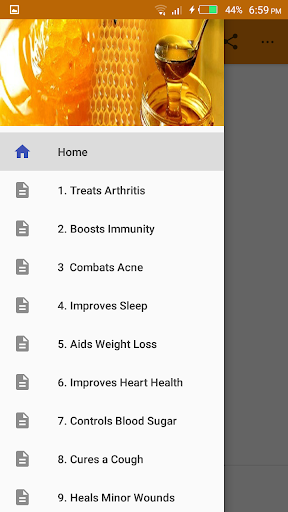
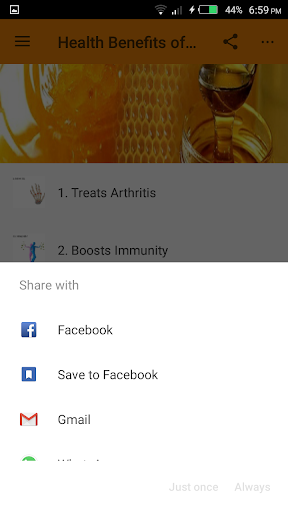
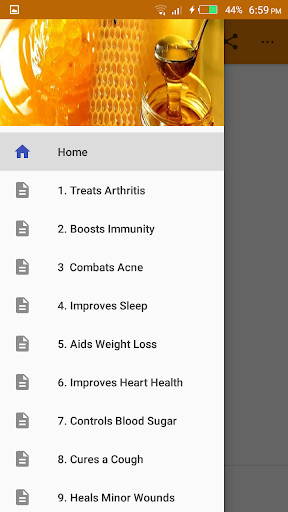
Yes; this exclusive app is nothing but a full package of some of the hidden but extremely useful health benefits of honey.
So, are you interested in health benefits of honey?
Do you want to know how honey has incredible benefits on health?
Are you interested in detailed elaboration?
Well then; here is the app absolutely free for you. Inside it you will find the detailed listing of health benefits of honey free.
Download the app totally free and explore the great benefits of honey today.
Here is the sneak-peak of the content you will receive inside the app:
Honey is so good we have included it in our list of power foods that should be in your kitchen at this moment. Find the health benefits of one of the oldest sweeteners on earths.
Note - This is content-only app that provides you information about health benefits of honey.
More about the most sweeties food on the planet
Honey /ˈhʌni/ is a sweet, viscous food substance produced by bees and some related insects. Bees produce honey from the sugary secretions of plants (floral nectar) or other insects (aphid honeydew) through regurgitation, enzymatic activity, and water evaporation, and store it in wax structures called honeycombs. The variety of honey produced by honey bees (the genus Apis) is the best-known, due to its worldwide commercial production and human consumption. Honey is collected from wild bee colonies, or from hives of domesticated bees, a practice known as beekeeping.
Honey gets its sweetness from the monosaccharides fructose and glucose, and has about the same relative sweetness as granulated sugar.[4][5] It has attractive chemical properties for baking and a distinctive flavor when used as a sweetener.[4] Most microorganisms do not grow in honey, so sealed honey does not spoil, even after thousands of years.
Providing 64 calories in a typical serving of one tablespoon (15 ml) equivalent to 1272 kj per 100 g, honey has no significant nutritional value.[8] Honey is generally safe,[9] but may have various, potentially adverse effects or interactions upon excessive consumption, existing disease conditions, or use of prescription drugs.
Honey use and production have a long and varied history as an ancient activity, depicted in Valencia, Spain by a cave painting of humans foraging for honey at least 8,000 years ago.
Honey is produced by bees collecting nectar for use as sugars consumed to support metabolism of muscle activity during foraging or to be stored as a long-term food supply. During foraging, bees access part of the nectar collected to support metabolic activity of flight muscles, with the majority of collected nectar destined for regurgitation, digestion, and storage as honey. In cold weather or when other food sources are scarce, adult and larval bees use stored honey as food
By contriving for bee swarms to nest in man-made hives, people have been able to semidomesticate the insects and harvest excess honey. In the hive or in a wild nest, the three types of bees are:
a single female queen bee
a seasonally variable number of male drone bees to fertilize new queens
20,000 to 40,000 female worker bees
Leaving the hive, foraging bees collect sugar-rich flower nectar and return to the hive where they use their "honey stomachs" to ingest and regurgitate the nectar repeatedly until it is partially digested.[13][15][17] Bee digestive enzymes – invertase, amylase, and diastase – along with gastric acid hydrolyze sucrose to a mixture of glucose and fructose.[13][15] The bees work together as a group with the regurgitation and digestion for as long as 20 minutes until the product reaches storage quality.[15] It is then placed in honeycomb cells left unsealed while still high in water content (about 20%) and natural yeasts, which, unchecked, would cause the sugars in the newly formed honey to ferment.
What's New
Version Information
- Version
- 2.0
- Downloads
- 5K+
- Updated on
- Oct 20, 2018
- Released
- Jul 18, 2017
- Requires
- Android 4.1
Statistics
Google Play Rating History
Rating Distribution
Downloads Over Time
Health Benefits of Honey has been downloaded times. Over the past 30 days, it averaged downloads per day.
Shaded area shows 30-day prediction based on historical trends
Historical data collection started recently. More data points will be available over time.
Health Benefits of Honey users say on Google Play
 A Google user
I love the app. The information therein is well presented
ApkTrusted Ratings & Reviews
More from AdamsDUT
See more apps
Beautiful Emotional Dua mp3
Free

Beautiful Quran Recitation mp3
Free

Punishment & Black Magic Ruqya
Free

Nigerian Food Recipes
Free

Abincin Hausawa (Hausa Recipe)
Free

Al-Sudais Full Quran mp3 Offli
Free
Benefits of Ginger
Free

Sheikh Sudais And 10+ Famous Q
Free

Beautiful Azan mp3
Free

Al-Sudais Juz Amma mp3 Offline
Free

Sheikh Jafar Arba Una Hadith o
Free

Sheikh Albani Zaria Audio mp3
Free

SHEIKH AMINA DAURAWA lectures
Free

Sheikh Fantami Hisnul Muslim 2
Free

Malam Kabiru Gombe Audio mp3
Free

Sheikh Kabiru Gombe Lectures
Free
Scan this QR code to download

Forwarding you to the page at Google Play market in seconds...
Open Google Play market now