Chemical Bonds vVARY
Hanoon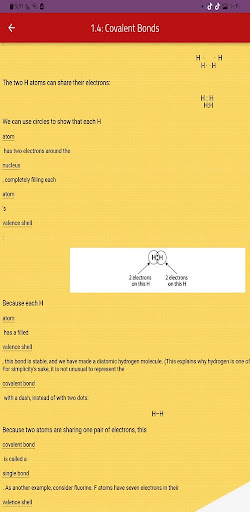



About this app
Developer Description
How do atoms make compounds ? Typically they join together
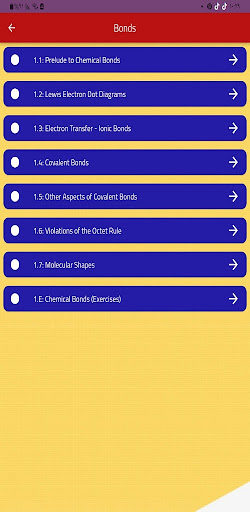
This App Chemical Bonds Contain :
1.1: Prelude to Chemical Bonds
Diamond is the hardest natural material known on Earth. Yet diamond is just pure carbon. What is special about this element that makes diamond so hard? Bonds. Chemical bonds.
1.2: Lewis Electron Dot Diagrams
Lewis electron dot diagrams use dots to represent valence electrons around an atomic symbol. Lewis electron dot diagrams for ions have less (for cations) or more (for anions) dots than the corresponding atom.
1.3: Electron Transfer - Ionic Bonds
The tendency to form species that have eight electrons in the valence shell is called the octet rule. The attraction of oppositely charged ions caused by electron transfer is called an ionic bond. The strength of ionic bonding depends on the magnitude of the charges and the sizes of the ions.
1.4: Covalent Bonds
Covalent bonds are formed when atoms share electrons. Lewis electron dot diagrams can be drawn to illustrate covalent bond formation. Double bonds or triple bonds between atoms may be necessary to properly illustrate the bonding in some molecules.
1.5: Other Aspects of Covalent Bonds
Covalent bonds can be nonpolar or polar, depending on the electronegativities of the atoms involved. Covalent bonds can be broken if energy is added to a molecule. The formation of covalent bonds is accompanied by energy given off. Covalent bond energies can be used to estimate the enthalpy changes of chemical reactions.
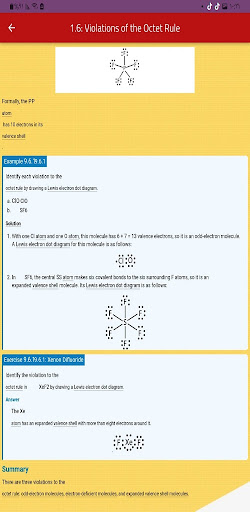
1.6: Violations of the Octet Rule
There are three violations to the octet rule: odd-electron molecules, electron-deficient molecules, and expanded valence shell molecules.
1.7: Molecular Shapes
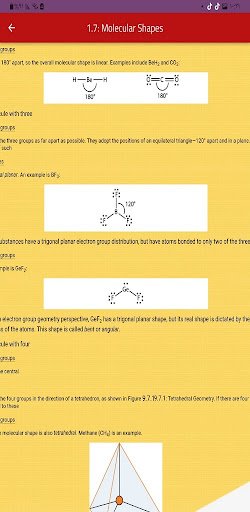
The approximate shape of a molecule can be predicted from the number of electron groups and the number of surrounding atoms
1:8 Chemical Bonds (Exercises)
These are exercises and select solutions to accompany Chapter 9 of the "Beginning Chemistry" Textmap formulated around the Ball et al. textbook.
Chemical bonds hold molecules together and create temporary connections that are essential to life. Types of chemical bonds including covalent, ionic, and hydrogen bonds and London dispersion forces.
Living things are made up of atoms, but in most cases, those atoms aren’t just floating around individually. Instead, they’re usually interacting with other atoms (or groups of atoms).
For instance, atoms might be connected by strong bonds and organized into molecules or crystals. Or they might form temporary, weak bonds with other atoms that they bump into or brush up against. Both the strong bonds that hold molecules together and the weaker bonds that create temporary connections are essential to the chemistry of our bodies, and to the existence of life itself.
Why form chemical bonds? The basic answer is that atoms are trying to reach the most stable (lowest-energy) state that they can. Many atoms become stable when their valence shell is filled with electrons or when they satisfy the octet rule (by having eight valence electrons). If atoms don’t have this arrangement, they’ll “want” to reach it by gaining, losing, or sharing electrons via bonds.
Version Information
- Version
- -
- Downloads
- 1K+
- Updated on
- -
- Released
- Jun 6, 2022
- Requires
- Android Varies with device
Statistics
Google Play Rating History
Rating Distribution
Downloads Over Time
Chemical Bonds has been downloaded times. Over the past 30 days, it averaged downloads per day.
Shaded area shows 30-day prediction based on historical trends
Historical data collection started recently. More data points will be available over time.
Chemical Bonds users say on Google Play
 nayla win
Good app
ApkTrusted Ratings & Reviews
More from Hanoon
See more apps
AC Repair Actron Guide : HVAC
Free
AC Repair Akai Guide : HVAC
Free
AC Repair AUX Guide : HVAC
Free

HVAC - Mechanical Engineering
Free
Integral Calculus
Free

California DMV : Driving Test
Free

Civil Engineering
Free

سعودی ڈرائیونگ پریکٹس ٹیسٹ
Free

DMV Handbooks : DMV
Free

Driving license - KSA: Traffic
Free

Driving Test Manitoba
Free

Ontario G1 - g1 practice test
Free
Driving Test Quebec : SAAQ
Free

Electrochemistry
Free

AC Repair Fujitsu Guide : HVAC
Free

AC Repair Goodman Guide : HVAC
Free
Scan this QR code to download

Forwarding you to the page at Google Play market in seconds...
Open Google Play market now